PINKS Golf Club, Jeju
A Premium Round Guide Explaining Exactly Why It Stays in Your Memory Long After Just One Visit
If you love golf in Jeju, there is one name you have almost certainly heard at least once: PINKS Golf Club.
This course is far more than simply a famous premium golf club. It is widely regarded as one of the places where you can most intensely experience Jeju’s natural terrain, wind, visual tension, and the precision of thoughtful course design. In fact, golfers who have played PINKS tend to describe it in very similar ways. Rather than saying, “It’s memorable because it’s beautiful,” they are much more likely to say, “It’s memorable because it’s difficult, deep, and powerful.”
PINKS is not the kind of golf course that welcomes players gently from the beginning. From the moment you stand on the first tee, the pressure created by the view and the strategic tension begin at the same time. The fairways do not open up generously, the bunkers are far more threatening than they appear, and the greens demand much more than simple speed control. For that reason, this is not a course that becomes easy just because you hit a few good shots.
What matters much more is where you choose to send the ball, how much ambition you allow yourself, which mistakes you are willing to accept, and how well you read Jeju’s characteristic wind and terrain. In other words, PINKS is not a course that tests only shot-making skill. It also demands the ability to interpret the course and manage your round. That is why it so naturally earns the label of a true golfer’s golf course.
Many golfers planning a Jeju golf trip hesitate over whether to include PINKS in their itinerary for exactly these reasons. It is expensive, not easy to book, and certainly not beginner-friendly. And yet so many golfers still choose PINKS as the highlight round of their trip. The reason is clear: the density of the experience and the quality of the memory left behind are on a completely different level.
In this guide, I will organize everything at once, from PINKS Golf Club’s basic information, costs, and reservation system to its course character, who it suits best, how to approach it strategically, and how to use it effectively within a Jeju travel schedule. Rather than simply listing facts, I will answer the kinds of questions real golfers actually ask when deciding whether this course is right for them.
To state the conclusion first: PINKS Golf Club is not just a prestigious course. It is one of Jeju’s highest-level premium strategic courses, one that tests technique, judgment, mental strength, and course understanding all at once.

Why You Need to Understand PINKS Golf Club First
If you understand PINKS merely as an expensive and famous golf course, you miss the real essence of it. This course has a personality that is far clearer than its price or reputation alone suggests. Your level of satisfaction depends greatly on the mindset you bring with you. If you go expecting a relaxed round while enjoying great scenery, it may feel much more difficult and tiring than expected. On the other hand, if you go in ready to read the design and solve each hole one by one, the course can offer extremely deep enjoyment.
When golfers talk about PINKS, one word comes up again and again: pressure. But this pressure does not come simply from narrow fairways. It is created by the visual tension, the intimidating presence of deep bunkers, the flow of the wind, the three-dimensional greens, and a design that punishes mistakes immediately. That is why PINKS is not the kind of course where you can casually get through one tee shot and one second shot without much thought.
The reason you need to understand this course beforehand is simple. PINKS is not a place where long hitters automatically have the advantage, nor is it a place that becomes easy just because your feel is good that day. Quite the opposite: it rewards the player who knows how to be patient, who looks at the safe zone instead of the pin, and who knows how to play for par. In other words, PINKS first asks not whether you are a golfer who hits it well, but whether you are a golfer who thinks well. If you understand that standard before you arrive, the round becomes far less shaky, and the overall satisfaction becomes much higher.
PINKS Golf Club at a Glance
PINKS Golf Club is a premium golf course located in Andeok-myeon, Seogwipo, Jeju. It is generally known as a 27-hole facility, and can be understood as operating with 18 members-only holes and 9 public holes. Even within Jeju, it is regarded as one of the very highest-level courses in terms of design, operation, and symbolic status.
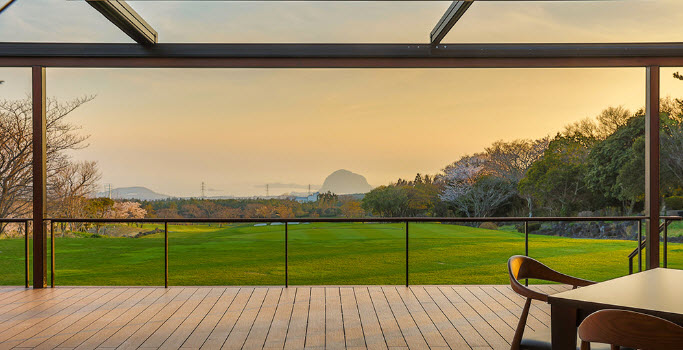
The most distinctive feature of this club is that it is an artistic course built directly into the natural terrain. This does not simply mean it is beautiful. Rather than covering over Jeju’s original landscape, wind, and visual flow with artificial resort styling, the course actively incorporates them into the design. That is why PINKS gives the impression not of a soft and easy resort course, but of a strong course where nature and design meet head-on.
Put into one sentence, it is this: PINKS is one of the most golf-like golf courses in Jeju, and one of the most demanding strategic layouts. That is not a dramatic line for effect. It is the character you feel most immediately once you stand on the course. That is why PINKS is not the kind of golf course you choose from a few lines of information. It is a course you choose based on what kind of round you actually want.
Why PINKS Is So Special in Jeju
There are many well-known golf courses in Jeju. But PINKS is talked about in a special way for reasons far beyond simple fame. It is a rare type of golf course where design, natural environment, and the actual playing experience combine into one powerful impression.
There are many good golf courses. But there are not many where, after the round, you still vividly remember specific holes, specific decisions, and even the direction of a specific wind. PINKS is exactly that kind of place. You remember why you aimed your tee shot that way, why the center of the green was the right answer instead of the pin, and how one poor wind decision led directly to punishment.
PINKS is also not simply difficult. Its difficulty is not random. It is rooted in design logic. The bunkers are placed exactly where you should not go. The greens allow you to hit them, but make it very hard to finish the hole easily. The wind and terrain reveal the value of each shot with unusual clarity. That is why PINKS is regarded as a brilliantly designed golf course.
Ultimately, the reason PINKS is so special can be summarized in one sentence: it makes you feel the true essence of golf, which is choice and responsibility, all the way through the round.
How Is the Location and Accessibility?
PINKS Golf Club is located in Andeok-myeon, Seogwipo, Jeju, so it does not feel like one of the very easy-access golf courses near the airport. It fits most naturally into a southwest Jeju itinerary, and even from the airport, the travel time needs to be factored in seriously.
This location comes with clear pros and cons. On the downside, it may feel burdensome as a rushed first-day round immediately after arrival. PINKS itself demands a great deal of physical energy and concentration, so if you combine that with too much travel strain, the overall satisfaction can drop.
But there are clear advantages as well. If you combine it with the Andeok area, Jungmun, or accommodations in the southwest part of the island, the travel flow actually becomes very good. More importantly, PINKS is a course that suits being the main round of the trip, so the little extra travel time can actually help create the feeling that “today is the real match day.”
That is why PINKS is not a golf course you should judge based on accessibility alone. It is much more accurate to think of it not as a convenient round, but as a course worthy of the most important day in your whole Jeju trip.
How Much Are the Green Fees and Total Costs?
By Jeju standards, PINKS Golf Club sits in the very top premium price range. Based on the user’s 기준, weekday green fees can be seen as approximately KRW 200,000 to KRW 250,000, and weekend green fees as approximately KRW 250,000 to KRW 300,000. On top of that, cart fees of around KRW 90,000 to KRW 100,000 and a caddie fee of around KRW 130,000 are added per team.
In realistic terms, the total cost per person usually comes out to roughly KRW 230,000 to KRW 350,000. This can vary depending on season, time slot, and package structure, but one thing is certain: this is not a course you book repeatedly because it is cheap.
It is perfectly natural to feel that this price range is high. PINKS is not a golf course valued for absolute affordability. Instead, it is closer to a course chosen for one truly premium round in Jeju. In other words, the cost should not be viewed simply as expensive or cheap, but in relation to what kind of day you want to create.
If you are imagining an easy sightseeing-style round, it may feel expensive. But if you see it as the main round of the one day you are looking forward to most in Jeju, the price can feel entirely justifiable.
Reservation Structure and Realistic Booking Tips
Because PINKS Golf Club operates strongly with a member-priority character, it is not an easy course for general reservations. Realistically, it is best understood as moving through a structure such as applications opening around 8 weeks in advance and allocations being made around 7 weeks in advance. In other words, the idea that you can simply choose the date you want and automatically get in does not really apply here.
During peak seasons or for desirable time slots, competition is especially intense. For general golfers with fixed travel dates, the booking difficulty can feel quite high. That is why, in practical terms, accommodation packages or linked travel products are often more realistic than trying to secure an individual standalone reservation. When lodging is bundled in, the chances of access may improve somewhat.
If I had to summarize the reservation tip in one sentence, it would be this: PINKS is not a course you squeeze in at the end. It is a course that should be placed at the center of the itinerary first. That gives you a better chance of securing the date you want, and also makes the whole trip far more stable.
Overall Course Structure and Design Philosophy
The overall structure of PINKS Golf Club can be expressed most briefly like this: pressure from the tee, choice on the second shot, punishment on the green.
That is not just a dramatic phrase. It describes the actual flow of the round almost exactly.
The tee shot is not comfortable from the start. The tension created by the view, the width of the fairway, and the presence of surrounding bunkers all act together, so even the first shot immediately fills your head with decisions. But the real difficulty comes after that. Even if you survive the tee shot, you still have to recalculate angle, yardage, wind, and pin position on the second shot.
The greens are not merely fast. They are highly complex. The undulation is strong, and the risk around the pin is significant, which means that simply hitting the green is less important than where on the green the ball finishes. The bunkers do not function as decoration. They act more like a message telling you very clearly: this is not where you should go. The design philosophy of PINKS is not to torture golfers for the sake of it, but to show, all the way through, why the choice behind every shot matters so much.
That is exactly why PINKS becomes not just a famous course, but a course whose design intentions must be read.
The Real Reason PINKS Feels So Difficult
If you describe PINKS as difficult simply because the course has a high degree of difficulty, that is not enough. The real reason is much more layered. The fairways are not wide, the bunkers are deep and forceful, the greens are fast and three-dimensional, the wind is strong, and the natural terrain remains very much alive. The important point is that these factors do not act separately. They all act at the same time.
At first glance, the tee shot can seem manageable if approached conservatively. But on the second shot, the wind, angle, and pin position overlap, making decisions extremely difficult. Even if you just manage to hit the green, the putting line is rarely straightforward, and small mistakes quickly turn into three-putts or difficult recovery shots.
In other words, PINKS is not a course that occasionally forces one very difficult shot. It is a course designed so that truly easy choices almost never exist. That is why the burden is enormous for beginners, and even intermediate or advanced golfers feel mental tension on almost every hole. The true difficulty of PINKS lies not in any single feature, but in the structure itself.
A Structure Where the Pressure Starts from the Tee
PINKS does not allow players to relax from the tee. It feels less like an open and flowing start, and more like a place where you must first decide where the safest place to send the ball is. The key here is not just hitting the fairway, but also understanding which side keeps the next shot open.
Many golfers make mistakes on the first shot because they approach PINKS as if it were a general resort-style course. It can look as though you only need to swing the driver toward the visible direction, but in reality, even a small difference in landing position can completely change the angle of the second shot. That is why judgment comes before confidence on the tee at PINKS.
Position matters more than power, management matters more than aggression, and you need to decide in advance what kind of miss you are willing to accept. That is why it feels so natural to say that the pressure begins right from the first hole. PINKS is not a place where you warm up into the round. It is a place you must begin reading immediately.
Why Scores Separate on the Second Shot
The true contest at PINKS is decided on the second shot. Even if the tee shot is handled reasonably well, one poor decision with the second shot can quickly turn the flow of the hole toward bogey or worse. This course does not simply ask whether you can attack the green. It asks from what angle, into which zone, and under what risk.
Even from the same yardage, the correct play changes completely depending on the direction of approach. In some cases you can see the pin clearly, while in others the center of the green is the only sensible target, or even a lay-up is the correct answer. The most common mistake here is direct pin-hunting. The moment ambition takes over, bunkers, downhill putts, side slopes, and short-side risk can all begin acting together. By contrast, aiming for the middle of the green may feel conservative, but the overall expected score becomes much better.
So the second shot at PINKS is not really about shot-making skill. It is about management. Knowing where to hit the ball matters far more than simply hitting it well.
Why the Greens Feel So Intimidating
The greens at PINKS are not merely fast. They are complicated. The undulation is strong, pin positions can make the difficulty swing dramatically, and a mistake on the first putt can very quickly turn into a three-putt. That is why so many golfers describe the greens at PINKS as frightening.
The moment the ball reaches the green, the tension begins rather than ends. If you force the approach too close to the pin and leave yourself a downhill or sidehill putt, even a short second putt can suddenly feel uncomfortable. In the end, the difficulty of the greens is not just about putting skill. It is about where you chose to leave the ball.
The same green in regulation can feel entirely different depending on whether it leaves an uphill putt or a downhill one. That is why, at PINKS, a good position matters much more than being physically close to the hole.
The Pressure Created by Bunkers and Hazards
The bunkers at PINKS are deep and forceful. They do not just cost strokes. They also deal psychological damage. The hazards do not simply create visual fear either. They work by narrowing the player’s available decisions. That is why, on this course, it is far more important to make choices that avoid bringing bunkers and hazards into play in the first place than to focus on heroic shots that carry them.
The moment you go into a bunker, the hole often changes from an attacking hole into a survival hole. If the escape is less than clean, a hole that was about making par becomes a hole about preventing double bogey. Hazards function in a similar way. They shake direction on the tee, restrain over-aggression on the second shot, and later in the round they even affect the mind.
Ultimately, the bunkers and hazards at PINKS are not just obstacles. They are messages from the architect. They say, very clearly, do not go there. If you can read that message, you can begin to solve PINKS properly.
Why the Wind Is More Than Just a Variable
Wind is always important in Jeju golf, but at PINKS it feels less like a variable and more like part of the course itself. Because the view, terrain, and elevation changes all work together, the same club can produce completely different results.
The real problem is that wind does not only change distance. It shakes decision-making itself. The moment you start doubting whether to take one more club, whether to flight it lower, whether to aim for the center, or whether to lay up, your swing begins to shake too. And when the course is already this difficult, adding wind makes the mental calculation far more complicated.
That is why dealing with wind at PINKS does not mean trying to overpower it. It means lowering expectations, reducing forced aggression, and shifting toward center-green strategy. The right answer is not to beat the wind, but to include it in the calculation.
The Biggest Strengths of PINKS
The biggest strength of PINKS is the completeness of its design. It would not feel exaggerated to call it one of the top courses in the country in that regard. Nature and strategy are fused together with extraordinary power. It is not just a course with excellent maintenance. It is a course that makes the player understand directly why each hole is shaped the way it is.
The second great strength is the overwhelming natural environment. The wind, terrain, and visual flow of Jeju do not function merely as a backdrop. They become part of the play itself. That is why, at PINKS, the scenery becomes strategy.
The third is strategic depth. This is not a place where distance golf dominates. It demands highly complete management, and for that reason, the longer someone has played golf, the more deeply they tend to appreciate the course. It is difficult, and that is exactly why it stays in the memory. It is exhausting, and that is exactly why it stays in the mind afterward.
Weaknesses and Drawbacks
The first drawback you feel most immediately is the price. PINKS sits at one of the very highest price levels in Jeju, which makes it hard to approach casually. The second is the difficulty itself. It is extremely challenging for beginners, and even for intermediate golfers it can shake confidence and mental balance. It is not a course that opens up just because you hit a few good shots, so on a day when your condition is not sharp, the perceived difficulty can rise even more.
The third is the difficulty of getting a reservation. Because the structure is strongly member-oriented, general bookings are limited, and securing a good tee time is harder than many expect. The final drawback is the wind factor. The course is already difficult, and when strong wind begins to work on top of that, both club selection and mental control become much more unstable. In the end, the drawbacks of PINKS are not just small inconveniences. Many of them are inseparable from the very identity of the course.
Who PINKS Suits Best
PINKS is best suited to golfers who want to experience a truly serious golf course. It is not the kind of place where you simply check off a famous name once. It suits the golfer who wants to feel the architecture and nature physically through the round. In terms of ability, it tends to suit intermediate and above, especially golfers around bogey-player level through to single-digit handicaps. At that level, a player is less likely to be crushed only by the difficulty and more able to enjoy why the course has been designed the way it has.
It is also highly recommended for anyone planning a premium round in Jeju. If your trip needs one true highlight day, PINKS can absolutely fill that role. It suits golfers who care more about the density of the round and the quality of the course than simply about the number on the scorecard.
Who It Does Not Suit, and When Expectations Need Adjusting
It is difficult to recommend PINKS to beginners. It is not that playing is impossible, but the combination of pressure, greens, wind, and bunkers can feel overwhelmingly difficult. It also does not fit well into a trip built around value for money. The cost is high and reservations are difficult, so it simply does not match an itinerary focused on playing many cheaper rounds.
It also requires expectation adjustment if what you want is a comfortable round or a lighthearted day with companions. PINKS is not a relaxed course. It is a course that demands concentration to the very end. Ultimately, it is not a golf course that is good for everyone. It is a golf course that is much better for people with a clear purpose.
How to Use PINKS in a Jeju Golf Trip
The ideal use of PINKS in a Jeju trip is as a single highlight round. Rather than playing it multiple times, it suits being concentrated into the one day you are looking forward to most. For example, it is quite persuasive to adapt on the first day at a course like Ecoland or Elysian, experience another strategic course such as Teddy Valley on the second day, and then play PINKS on the final day or on the day when your condition is best.
In particular, because PINKS is a course where physical energy and concentration make a big difference in how much you appreciate it, it is best not to overload it with travel or too many extra plans. An accommodation package can also be a practical choice. In the end, PINKS should be treated not as a supporting course in the itinerary, but as the main event.
Core Practical Strategy
The first principle in attacking PINKS is to reduce greed from the tee. The fairways are not generous and the pressure is strong, so on many holes survival matters more than maximum distance. The second principle is to think about the second-shot angle first. Before you ever think about attacking the pin, you need to decide from which direction you want to approach, what kind of miss you can allow, and whether the center of the green is the real answer.
The third principle is center over pin. At PINKS, a good putting position matters more than closeness to the flag, and on fast, complicated greens, the best possible result may simply be the place that leaves an uphill putt. The fourth principle is to calculate both wind and bunkers together. You cannot think about only one of them. The moment a wind-affected shot drifts into a bunker or hazard, the score can collapse immediately.
Common Patterns That Cause Scores to Collapse
The most common pattern that causes scores to fall apart at PINKS is greed from the tee. Many golfers try to overpower the pressure and hit too aggressively, only to find the ball in the worst possible position. The second is direct pin-hunting on the second shot. In situations where the center of the green would have been enough, ambition brings bunker, hazard, and downhill putting risk into play all at once.
The third is ignoring the wind. If you trust only the yardage you see with your eyes, a one-club mistake at PINKS can come back as an immediate major penalty. The fourth is over-aggression on the greens. Instead of trying to finish in two, golfers try to hole the first putt, and the moment that happens, three-putts increase very quickly. In the end, the reason a hole that could have been a par becomes a double or triple usually begins with one of these four patterns.
Conclusion
PINKS Golf Club is not simply a prestigious golf course. It deserves the phrase “the most golf-like golf course in Jeju” because it demands technique, judgment, mental strength, and management at the highest level. The pressure begins right from the tee, one second-shot angle can change the entire hole, and the greens keep demanding concentration even after you reach them. Once the wind and the natural terrain are added in, PINKS becomes more than just a difficult golf course. It becomes a course that tests every part of a golfer’s ability.
That is why this course does not offer easy satisfaction to everyone. But if you prepare properly and approach it strategically, it has a very high chance of becoming the most powerful golfing memory you make in Jeju.
Put into one sentence:
PINKS Golf Club is Jeju’s highest-level premium course, a place where you collapse immediately if you play by feel, but where strategy can create one of the best round experiences you will ever have.