Why Scores Collapse on the Second Shot
A Complete Strategy Guide to Serenity Gangchon CC in Chuncheon
The way golfers choose a course has changed a lot from the past.
In the past, the main factors were distance, price, and how easy it was to book a tee time. If a course was close enough to Seoul, the green fee felt manageable, and you could secure a weekend tee time, that was usually enough to make the decision.
But golfers today are starting to ask more essential questions.
- What kind of golf does this course demand from me?
- What part of my game does this course expose?
- Is this simply a place to hit balls, or is it a place that tests my judgment and skill?
Serenity Gangchon CC in Chuncheon is exactly the kind of course that makes you look at things this way again.
On the surface, it looks like an upper-mid-level public course with good access from the Seoul metropolitan area. The price is not exactly cheap, but it is not at the level of an ultra-premium private club either. So many golfers initially think of it as simply “a decent public course in good condition.”
But once you actually play it, you quickly realize that the true nature of this golf course lies somewhere else.
This is not a course where the tee shot feels overwhelmingly intimidating. In fact, the first impression is often more comfortable than expected. The view is not completely blocked, and on some holes the fairway even looks fairly generous. So many golfers start out thinking:
“If my driver behaves today, this should be an easy round.”
But the moment that confidence starts to break is on the second shot.
The tee shot is in play, but when you get to the ball, the lie is awkward.
The distance seems manageable, but the uphill and downhill change club selection.
The green is visible, but the angle to the pin is unclear, and the moment you get a little greedy, you are left with a long putt or a difficult approach.
There is a very clear reason so many golfers at this course end up asking:
“Why did I hit my tee shots well and still fail to score?”
It is because Serenity Gangchon CC is a golf course where position matters more than distance, second-shot angle matters more than the tee shot, and calculation matters more than swing feel.
In other words, the driver is only the beginning here. Your actual score is decided by your irons and your distance judgment.
In this guide, I will take an in-depth look at Serenity Gangchon CC’s basic information, its accessibility and cost, the reservation reality, the character of the Hill and Forest courses, the structure that causes golfers to fall apart on second shots, and the real strategic points that can help prevent that from happening. This is not simply an introduction—it is a practical guide for golfers who genuinely want to lower their score.
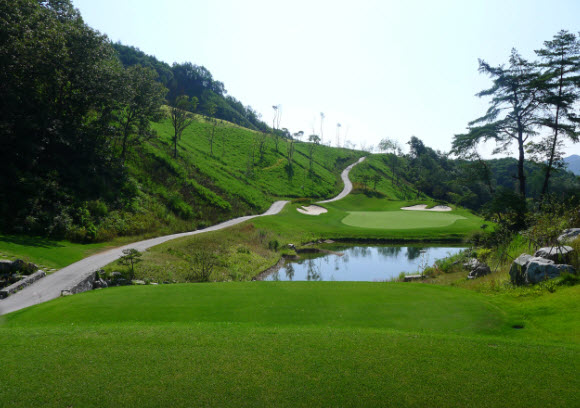
What Kind of Golf Course Is Serenity Gangchon CC?
Serenity Gangchon CC in Chuncheon is an 18-hole public golf course located in Nam-myeon, Chuncheon, Gangwon Province.
It is made up of two 9-hole courses, the Hill Course and the Forest Course, with a total yardage of around 7,000 yards. On paper, it may look like an ordinary public course, but the actual style of play is far more strategic.
After a recent renovation, the overall course condition has improved noticeably, and that change has had a significant effect on player satisfaction. Turf condition, green quality, the flow between holes, and the overall management standard have become more stable than before, and the course is increasingly being re-evaluated not just as an accessible public course, but as a strategic upper-mid-level golf course.
If I had to define this course in one sentence, it would be this:
“A golf course where the tee shot looks comfortable, but where the quality of your second shot and your judgment decide the score.”
In other words, this is not a course that overwhelms you from the beginning, but once you start playing, it becomes clear that the holes require a much more precise way of being managed.
You cannot relax just because your driver is working.
And just because the ball is in the fairway does not mean the hole has become easy.
The real difficulty of Serenity Gangchon begins right after the tee shot.
That is why this course may feel unexpectedly difficult to beginners, while at the same time becoming an interesting test course for intermediate and better players who already understand some level of strategic golf.
So rather than calling it simply “a difficult golf course,” it is more accurate to say:
“It becomes difficult if you play without thinking, but if you understand it, it opens up in a very logical way.”
Accessibility Is One of the Most Practical Strengths of This Course
One of the first strengths people mention about Serenity Gangchon CC is its accessibility.
From Seoul, it is roughly around an hour away, which is clearly a major advantage. Of course, the actual time depends on your departure time and traffic conditions, but for golfers in the metropolitan area, it is close enough for a same-day round and feels more like “a course worth visiting” than “a course that is too far to bother with.”
This matters more than many people realize.
No matter how good a golf course is, if the trip itself is too exhausting, it becomes difficult to visit repeatedly. On the other hand, when accessibility is good, and the course itself delivers a satisfying enough experience, the likelihood of repeat visits rises sharply.
Serenity Gangchon sits exactly in that sweet spot.
It is not an extreme destination course for a special trip, but a strategic public course that you can realistically come back to again.
Especially now, when golfers are making more practical decisions about where to play, this kind of accessibility matters even more. You do not have to commit an entire day to the journey alone, and it is entirely realistic to leave in the morning and return in the evening. For golfers who want to focus more on the round itself, that makes it a very appealing option.
So the value of Serenity Gangchon’s accessibility goes beyond simply being “close.”
It is valuable because it is:
“A realistically positioned course where you can experience strategic golf and still come back again.”
The Cost Is Upper-Mid-Level, but Understandable Once You Understand the Course
By public-course standards, Serenity Gangchon CC is not particularly cheap.
Weekday green fees often sit in the upper KRW 100,000 range, and weekend fees are often in the mid-KRW 200,000 range. Once cart and caddie fees are included, the total cost per player can rise into the low-to-mid KRW 300,000 range. That means it is difficult to describe this as a pure “value-for-money” course. It fits more somewhere between upper-mid-level and near-premium pricing.
What matters here, however, is not simply whether that cost feels high or low, but what kind of experience comes back in return.
If you think of Serenity Gangchon only as “a public course in decent condition,” the price can feel a little high. But if you consider the course layout, the improved conditioning after renovation, the second-shot-centered strategy, and the good accessibility together, it becomes harder to call the price excessive.
Of course, if you go in expecting a strongly premium, luxury-level experience, there may still be some disappointment. In other words, the price has risen enough that if a golfer expects the symbolic prestige or luxury image of a top private club, there can be a gap between expectation and reality.
But if you define it instead as:
“A strategically designed public course in a very good location,”
then the price structure becomes much easier to accept.
So in the end, Serenity Gangchon is not a course that wins on pure value alone, but it is a course with a very persuasive price point for golfers who care about strategy, accessibility, and course condition together.
Reservations Are Not Extremely Tight, but Good Times Require Early Action
Reservations at Serenity Gangchon CC are mainly handled through the official website.
It works through a relatively simple online booking system after 회원 registration, so the system itself is not difficult to access. The reservation difficulty is also not at the level of ultra-premium golf clubs. In other words, this is not “a course you simply cannot book.”
But that does not mean you can always secure your preferred time slot without effort.
Weekend morning tee times and desirable slots during good-weather seasons definitely face competition. So if you want to enjoy this course comfortably, it is important not to miss the reservation opening window.
Because the accessibility is good and satisfaction has improved after the renovation, the demand has become more stable and consistent. If you assume there will always be good leftover times at the last minute, you may end up with only less desirable options.
So the most accurate way to describe the reservation situation is:
“Not impossible, but easy enough only for those who prepare—if you relax, you may miss the time you really want.”
The Overall Course Structure Is Far More Second-Shot-Oriented Than It Looks
The structural reason Serenity Gangchon CC feels difficult is actually quite simple:
The tee shot looks comfortable, but the real difficulty of the hole begins on the second shot.
This course is a classic strategic layout built around elevation changes and carefully designed landing zones.
When you stand on the tee with a driver, many holes look quite manageable. At first glance, it is easy to think, “This seems pretty reasonable.” But the moment the ball lands and you walk up to it, the real intention of the hole reveals itself.
A drive that felt good may end up sitting on a side slope.
A ball that looked central may still leave a blocked angle into the green.
The distance may be shorter, but the uphill or downhill lie can make club selection more difficult than expected.
In other words, at this course, a good drive does not automatically guarantee a smooth hole.
The tee shot is closer to a preparation stage for the second shot, and your actual score is decided by where you can send the iron shot, at what height, and with what sense of distance.
That is why golfers who repeatedly lose strokes at Serenity Gangchon usually do not collapse because of the driver. Instead, they lose strokes because their decisions after the tee shot—especially their second-shot angle and distance adjustment—keep going slightly wrong, hole after hole.
For that reason, this course is actually one that slightly better players are more likely to underestimate than beginners.
They assume that if the driver is in play, the hole will unfold well.
Then they find themselves unraveling in a chain reaction with their irons and on the greens.
The Hill Course Shows Most Clearly Why Elevation and Distance Adjustment Matter
The Hill Course is where the strategic nature of Serenity Gangchon becomes most obvious.
As the name suggests, elevation change plays a major role here, and the position of the ball after the tee shot, along with the judgment of the second-shot distance, becomes extremely important. Some holes also create slight visual deception, so if you simply rely on your usual feel, small errors appear very easily.
The core of the Hill Course is distance calculation.
On uphill shots, you often need one more club than expected.
On downhill shots, the ball travels noticeably farther.
The problem is that this difference is not always extreme. More often, it appears in that awkward zone where you hesitate over whether to take one more club or not. That uncertainty is exactly what starts to cost strokes.
The common mistake golfers make on the Hill Course is thinking:
“This should be fine with my normal distance.”
But that single lazy assumption leads directly to a front bunker, a short miss, or a long putt—after which the pressure on the putting only increases.
In other words, the Hill Course does not reward the player who swings hardest.
It rewards the player who is most disciplined and honest about distance adjustment.
Even though the holes may look manageable, the moment you ignore that basic principle, the penalty shows up immediately.
The Forest Course Looks More Comfortable, but Direction and Second-Shot Precision Matter Even More
Compared with the Hill Course, the Forest Course often feels calmer and more stable.
The visual pressure is a little lower, and on some holes it creates the impression that you can manage things more comfortably. But that sense of comfort is exactly why mistakes often appear.
The core of the Forest Course is direction and second-shot precision.
Even if the tee shot does not look very threatening, a drive that finishes in the wrong position can leave a surprisingly awkward second shot. The pin may seem visible, but the actual angle into the green may not really be open, or the slope may make club selection trickier than it first appears.
So the Forest Course is not really an “easy course.”
It is closer to a course that makes you mistakenly believe it is easy.
That is why it is common to see golfers relax after a good tee shot and then immediately fall apart on the second.
The players who produce good results here are usually the ones who never lose concentration after the driver. Even when the tee shot is good, they do not become more aggressive. If anything, they look even more carefully for the broadest part of the green and the position that leaves the simplest first putt.
The Key to Tee-Shot Strategy Is Not Just Survival, but Leaving the Next Shot Open
There are plenty of holes at Serenity Gangchon CC where the fairway looks wide enough from the tee.
That leads many golfers to think:
“As long as I get it in the fairway, I should be fine.”
But the design of this golf course is not that simple.
The key is the landing zone.
Even within the same fairway, the difficulty of the second shot can change significantly depending on which side the ball finishes on. From one position, the green may open up straight ahead. From another, even if the pin looks visible, the actual line of attack is uncomfortable.
So the purpose of the tee shot cannot simply be survival.
It must be:
Creating a position from which the next shot is actually playable.
That is why, when evaluating a tee shot here, you need to ask not:
“Did I hit it well?”
but rather:
“Did I put it in the right place?”
If you repeatedly find yourself with a ball that is in play but a blocked or uncomfortable second shot, the problem is not necessarily your driver swing. It may be your understanding of the landing zone.
Second-Shot Distance Judgment Is the Real Deciding Point of This Course
The true scoring battleground at Serenity Gangchon is the second shot.
The tee shot can generally be managed.
But on the second shot, you must think simultaneously about the green, the pin, the distance, the elevation, the run, and the slope. It cannot be solved by swing feel alone.
In particular, if you approach second shots here with the simple idea that “getting on the green is enough,” you are likely to lose strokes.
Even when you hit the green, the result depends entirely on:
- which tier you are on
- whether you are above or below the pin
- whether the first putt is uphill or downhill
So getting on the green is only the beginning of success.
Where on the green you leave the ball matters much more.
That is why second shots here should be aimed not at the pin first, but at the safe zone and the difficulty of the putt you are leaving yourself.
A shot that creates a birdie opportunity is less valuable than a shot that prevents bogey and gives you a simple two-putt par.
At Serenity Gangchon, a good iron player is not the golfer who keeps attacking flags. It is the golfer who knows how to avoid the dangerous side and place the ball on the easy side.
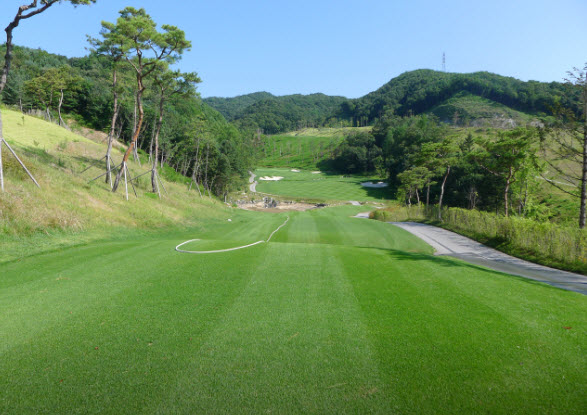
Elevation Response Sounds Basic, but on This Course the Basics Matter Most
Before the round, many golfers repeat the same basic ideas:
“One more club uphill, one less club downhill.”
The problem is that once they get out onto the course, they forget those basics very easily.
And on a course like Serenity Gangchon, where elevation changes repeatedly come into play, those basic principles matter even more. The reason is that the visual landscape and the actual playing yardage often differ slightly—and that slight difference is enough to decide the result.
Many mistakes on this course are not huge calculation failures.
They come from small moments of carelessness:
“This should be close enough.”
You take your normal club uphill and come up short.
You get greedy downhill and fly it long, leaving a difficult putt.
And then those little errors pile up until the score collapses.
So at Serenity Gangchon, elevation adjustment is not some special skill.
It is simply the question of whether you can keep honoring the fundamentals until the end.
The moment you get lazy with the basics, the course punishes you immediately.
The Green Is Not an Attacking Zone, but the Final Defensive Zone
The greens at Serenity Gangchon CC are quick and have meaningful undulation.
They may not feel as overwhelmingly intimidating as those at elite members-only clubs, but by public-course standards, they are absolutely not easy.
Especially when a second shot finishes on the wrong part of the green, the chance of three-putting rises very clearly.
The green strategy here is extremely clear:
Center before pin.
Two-putt before birdie.
When a second shot leaves only a short iron or wedge, many golfers want to attack the flag directly. But the moment that shot misses slightly and finishes on an awkward slope or the wrong tier, it becomes much harder to save par.
That is why, at this course, the green should not be thought of first as a place where you stick it close. It should be understood as the place where you stop mistakes from getting larger.
The best green shot is not the one that creates the shortest birdie putt.
It is the one that leaves the easiest first putt.
If you understand it that way, the greens at Serenity Gangchon become much more logical to manage.
The Typical Flow Here Is Comfort Early, Then Unraveling in the Middle
There is a very common pattern many golfers experience at Serenity Gangchon.
The opening stretch feels easier than expected.
The tee shots do not seem too intimidating, and the early rhythm is not bad. So it is very easy to start thinking:
“This could be a good day.”
But from the middle part of the round, the feeling changes.
Second shots begin piling up from awkward lies or awkward distances.
You start attacking pins and leaving long putts.
Small elevation-adjustment errors begin stacking up, and suddenly bogeys and worse start to appear again and again.
In the end, the swing itself did not collapse.
What happened was that small judgment errors accumulated until the score became heavy.
That is what makes this course dangerous.
It is not a course that scares you from the beginning.
It is a course that quietly shakes your rhythm little by little.
That is why complacency is the biggest enemy here.
If your driver survives early and you assume the round will therefore go well, that is often exactly when the damage on second shots begins.
The Strengths Are Clear, but Satisfaction Depends on Matching Expectations Correctly
The strengths of Serenity Gangchon CC are very clear.
First, the accessibility is strong.
Second, the overall balance between course quality and strategy is good.
And the improved condition after renovation is also a meaningful plus.
In short, one of this golf course’s biggest strengths is that it offers a fairly serious strategic golf experience without being too far from the Seoul metropolitan area.
But there are also limitations.
The price is not truly light, and for some golfers, the level of “premium emotion” may not fully match that price.
Also, because elevation change plays a significant role, players looking for a purely comfortable, easygoing round may find it more tiring than expected.
So this is not really a course you should approach as:
“A casual public course where I can just go and have fun.”
It is better approached as:
“A place where I can experience strategic golf at a reasonable but still meaningful price.”
That is when satisfaction tends to rise.
Who Will This Course Suit Best?
Serenity Gangchon CC suits golfers in roughly the 80-to-95 score range particularly well.
It is ideal for players who enjoy courses that cannot be solved with the driver alone—courses where second shots and distance adjustment really matter—or for golfers who want to examine the quality of their course management.
In other words, for players who enjoy strategic golf, this course can be an excellent choice.
On the other hand, it may feel burdensome for beginners, or for golfers whose goal is simply:
“Let’s just go out and have a relaxed round.”
Even though the tee shots appear comfortable, the second shots constantly demand judgment, so for players who do not yet have stable distance control and enough course understanding, the round can feel tiring rather than enjoyable.
Real On-Course Strategy Can Be Summarized in Three Points
The key to protecting your score at Serenity Gangchon is not actually complicated.
It really comes down to three things:
First, view every tee shot from a position-first mindset.
Survival is not enough. The next shot needs to be left open.
Second, on second shots, look for the safe zone before you look at the pin.
What matters more than simply hitting the green is what kind of putt you are leaving yourself.
Third, never treat elevation adjustment casually.
This course punishes you the moment you get lazy with the fundamentals of distance correction.
If you can simply hold onto these three principles until the end, Serenity Gangchon feels much more logical and much easier to play.
Final Conclusion and Overall Assessment
Serenity Gangchon CC in Chuncheon is not just another public golf course.
Its price is upper-mid-level, but the course itself is not generic public golf. It has a very clear strategic character, and the core of that strategy lies not in the driver, but in the second shot.
The tee shots look more comfortable than expected.
But the real golf begins only after the ball lands.
From there, position becomes more important than distance, angle becomes more important than pure swing quality, and calculation becomes more important than feel. And those differences show up very honestly on the scorecard.
So if I had to summarize this golf course in one sentence, it would be this:
Serenity Gangchon CC in Chuncheon is a golf course where your real ability is revealed not by the driver, but by the second shot.
If you understand that structure before you play, the course stops feeling like an intimidating public course and becomes a very attackable strategic test course.
If you do not understand that structure, then no matter how well your driver behaves, you may leave the round still wondering why the score never came.
For golfers who want to find a balance between value and strategy, and who want to experience real course management within easy reach of the metropolitan area, Serenity Gangchon CC is absolutely a golf course worth experiencing more than once.