Complete Hole-by-Hole Strategy Guide to Ladena Golf Club in Chuncheon
The True Deciding Factors of a Prestigious Strategic Course, Read from a Pro’s Perspective
Introduction
When golfers in the Chuncheon area talk about wanting to experience a truly high-quality golf course, one name always comes up: Ladena Golf Club. This course is more than just a famous private club. It is widely regarded as a place where course quality, maintenance standards, and the overall density of play are all evaluated at a very high level.
When you first arrive, the wide and well-manicured fairways, calm scenery, and polished course atmosphere can make it feel more comfortable than expected. But once the round begins, that first impression quickly changes. Ladena is far more calculated than it looks.
The tee shots may appear inviting, but the landing areas are more limited than they seem. On approach shots, it becomes far more important to decide where to land the ball rather than simply aiming directly at the pin. And on the fast, precise greens, the ability to secure two putts often creates more value than chasing birdies.
This is not a golf course where one good driver swing suddenly makes a hole easy. Rather, the lie after the tee shot, the angle into the green, the placement of bunkers and hazards, and even the final putting distance are all organically connected.
That is why Ladena Golf Club tends to favor the golfer with refined thinking over the pure power hitter, and the golfer who steadily erases mistakes over the one who attacks every hole aggressively. Its 27-hole private-club structure, the course quality refined over many years, and the distinctly different character of the Lake, Garden, and Nature courses together make this course feel less like a place for a casual round and more like a fully developed competitive stage.
In this article, rather than simply introducing Ladena Golf Club, I want to focus on how to actually play it well. I will explain how the Lake, Garden, and Nature courses each test players in different ways, what choices are most efficient from a professional perspective, and how first-time visitors and intermediate-to-advanced players should approach the course differently.
If you are preparing to play this course, the first thing you should remember is this:
Ladena begins with the driver, but in the end, it is decided by your irons and your putter.
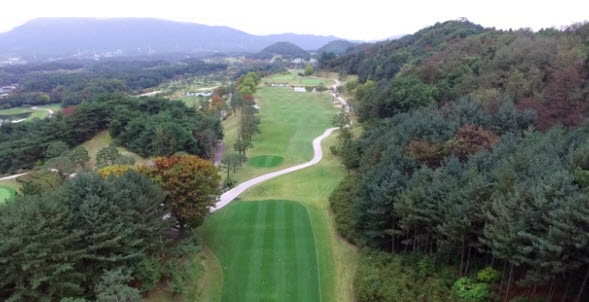
The Essence of Ladena Golf Club Lies Not in Individual Holes, but in Its Connected Structure
To properly understand Ladena Golf Club, you must first look beyond the number 27 and see how those 27 holes test the player. At a glance, the fairways feel relatively open, and as expected from a private course, the overall flow is well organized and never claustrophobic. Because of that, your first impression may be, “This looks easier than I expected.”
But this golf course uses exactly that first impression to unsettle the player.
The tee shots look comfortable, yet the second shots suddenly become demanding. The pin is visible, but the true target is often the safe zone rather than the flag itself. And the green structures repeatedly remind you that simply hitting the green does not mean the hole is under control.
Ultimately, Ladena’s true difficulty does not come from the width you see from the tee. It comes from the sequence that unfolds after the tee shot. If the landing point is even slightly off, the angle for the second shot narrows. If you get greedy on the second shot, the fast greens immediately bring the possibility of a three-putt into play.
When pros face this type of golf course, they do not focus only on playing each hole well in isolation. They first look at the rhythm of the entire round. Ladena is especially the kind of course where that mindset matters. More often than not, it is not enough to hit one good driver. You have to solve the hole by connecting the second and third shots as well.
That is why the core strategy here is very clear:
- Position on the tee shot
- Precision on the second shot
- Distance control on the greens
Only when these three elements keep connecting can you truly play a round that suits Ladena.
The 27-Hole Layout Is Not Just Scale — It Changes the Texture of Strategy
One of Ladena Golf Club’s defining features is its 27-hole layout, made up of the Lake, Garden, and Nature nines. Many golfers think of a 27-hole course as simply a symbol of size, but the real value lies in variety. Depending on the combination, this course can create completely different round experiences, and even repeat visits can feel new each time. That is one of the important values of a prestigious golf course.
The Lake Course is defined by visual pressure from water and the psychological tension it creates. The Garden Course emphasizes length, landing zones, and delicate green approach play. The Nature Course feels like the most strategic test of decision-making and mental control.
Because the three nines have distinctly different personalities, trying to push through all 18 holes with the exact same swing rhythm and level of aggression will eventually cause problems.
When pros look at a 27-hole course like this, they do not begin by asking, “Which course is harder?” Instead, they ask, “What type of mistake does each course try to induce?” That is also why Ladena is regarded so highly. It is not simply because each individual hole is special, but because each course has a clear identity, and that identity genuinely changes the rhythm of the round.
Ladena is not a course you fully understand in one visit.
In many ways, it begins to reveal itself only on the second and third rounds.
On the Lake Course, the Real Danger Is Not the Hazard — It Is the Unsettled Mind
As its name suggests, the Lake Course is one where water plays a visible role throughout the round. But what matters is not merely that hazards can lead to penalty strokes. The real issue is that they constantly blur your decision-making on both tee shots and approach shots. On this course, the greatest enemy is not the water itself, but the vague anxiety that appears the moment you see it.
Pros do not simply “try to avoid” hazards on the Lake Course. Instead, they first establish a clear safe line—one that is so definite that the presence of the hazard no longer affects their swing. This difference is enormous. Many amateurs see water and think, “I just can’t miss over there.” But this kind of thinking creates a blurred target. The body starts trying to avoid something, the eyes become unstable, and the swing hesitates. A pro, by contrast, reduces everything to one clear standard: “I am sending the ball here.” The water remains background information, not the target of attention.
The Lake Course is difficult not because it presents unmanageable technical obstacles. It is difficult because it prevents players from making their usual swings, even when they are fully capable of the shot.
That is why this course places far greater value on mental stability than on raw technique.
On the Lake Course, one moment of hesitation is more dangerous than one moment of aggression.
That is the true essence of Ladena’s Lake Course.
On the Lake Course Par 3s, the Correct Answer Is Not the Pin — It Is the Safe Middle
The par 3 holes on the Lake Course often combine forced carries over hazards, variable wind, and strong visual pressure. The most common mistake on these holes is trying to attack the flag directly. When the pin is placed in the front or close to the water, it is easy to think, “If I hit it close, I have a birdie chance.” But from a professional perspective, those are exactly the situations where aiming for the middle of the green is the stronger decision.
Especially when the wind is inconsistent or when the presence of water subtly shortens the swing psychologically, tempo becomes unstable before distance does. That is why the right answer is not aggression, but conservative precision. Hitting the center of the green and making a routine two-putt par creates a much higher expected value than forcing a risky birdie attempt. If a single par 3 disrupts your flow, the entire Lake Course can suddenly start to feel heavier.
On the Lake Course par 3s, the shot that removes danger is often better than the shot that merely looks good.
On the Lake Course Par 5s, the Quality of the Third Shot Matters More Than the Possibility of Reaching in Two
The par 5s on the Lake Course may look like opportunities for long hitters. In reality, however, they are where many of the biggest mistakes occur on second shots. When hazards come into play in the landing area or in front of the green, trying to advance too aggressively with the second shot can become extremely dangerous. Pros do not first ask whether they can reach in two. Instead, they ask: From what distance and what lie do I want to play my third shot?
If you can leave yourself a comfortable wedge yardage—say, 80 to 100 meters—that alone solves much of the hole. On the other hand, forcing the second shot from an awkward lie and ending up in a bunker, hazard, or uncomfortable slope can instantly turn a par 5 into a double-bogey hole.
The players who make birdies on the Lake Course par 5s are not necessarily the longest hitters. They are the players who know how to delay their greed on the second shot.
On this course, three good decisions are stronger than one big attack.
On the Tougher Lake Course Holes, You Need the Courage to See the Hole Shorter
On the long par 4s and other high-handicap holes on the Lake Course, thinking too long can itself become a trap. Many golfers look at such holes and think, “This is a hole where I need to hit it hard and long.” But pros often approach them the opposite way. They shorten the hole mentally and focus on reducing damage.
If both water hazards and difficult greens are involved, attempting an aggressive two-on strategy is often less professional than laying up and relying on an approach shot to protect par. This is not passive golf. It is actually an active strategy based on understanding where your game performs best. It is not about “hitting it shorter”; it is about creating an easier next shot.
The Lake Course rewards precisely this kind of shift in thinking.
The Garden Course Demands More Precision Because of Its Length
The Garden Course does not intimidate in the obvious way the Lake Course does. For that reason, many golfers relax mentally when they arrive there. But that comfort is exactly where the danger begins.
The Garden Course looks long and stable, yet in reality it frequently uses subtle placements of landing zones and approach angles to unsettle the player. Courses like this often cause more mistakes than courses that look openly difficult, because when players feel comfortable, they are most likely to let go of their routine.
Pros never take the Garden Course lightly. The longer a course becomes, the more important tee-shot accuracy becomes. And the longer the approach shot becomes, the more important it is to aim for the center rather than the flag. On holes with doglegs, they care less about cutting the corner and more about finding the angle that keeps the next shot alive. Even a slightly shorter tee shot can be the better landing area if it opens up the view and provides a stable lie.
On the Garden Course, the Real Question Is Not How Far You Hit It — But Where You Land It
The Garden Course often features holes with left-to-right or right-to-left bends where a single landing point can completely change the difficulty of the hole. Amateurs naturally want to shorten the dogleg. Pros, however, first look at the angle for the next shot. If you try to cut the corner and end up in a bunker, rough, or awkward slope, the remaining yardage may be shorter, but the actual approach becomes much more difficult. On the other hand, if you give yourself a slightly longer shot but an open view and stable lie, the second shot becomes far easier.
The Garden Course repeatedly presents tee shots that look attractive but are actually uncomfortable. That is why a good tee shot here is not the one that goes the farthest, but the one that makes the next shot easier.
The more a course looks long, the stronger this principle becomes.
On the Long Par 3s and Par 5s, One Miscalculation in Distance Can Change the Entire Flow
The long par 3s on the Garden Course often tempt golfers into thinking, “I just need to hit the green.” But in reality, distance calculation becomes the most important factor. On long par 3s where wind and obstacles come into play together, the first thing you must secure is not direction, but the necessary carry yardage. If you come up short, you are immediately in trouble. If you go long, there is often still a chance to recover from around the green.
For that reason, on these holes the flag matters less than the number you absolutely must cover.
The Garden Course par 5s are not simple just because they are long. In fact, their length makes distance errors feel even bigger. If you get greedy on the second shot and lose direction, the hole can collapse instantly. Pros do see these as scoring opportunities, but they choose their attacking moment late. They do not try to solve everything with the second shot. Instead, they design the hole so that the third shot comes from the best possible position.
The Garden Course must be played more simply because it is long,
and more precisely because it must be played simply.

The Nature Course Is the Most Strategic Battle of Judgment at Ladena
Among Ladena’s three nines, the Nature Course may be the one that makes you think the most. Natural terrain, valleys, and blind sections create a high volume of information before each shot. In other words, if you simply hit what you see, the chance of a mistake rises sharply. This is a course where the gap between the player who reads the flow in advance and the player who does not can become very large.
Pros raise the density of their course management one level higher on the Nature Course. Before the tee shot, they connect everything—the landing zone, the angle of the second shot, even which section of the green they intend to use. Otherwise, the next shot can suddenly become far more difficult.
You have to quickly sort out what to attack, what to give up, which holes are worth protecting with par alone, and which ones should be handed over to wedge and short-game play.
The Nature Course is the scariest when you arrive unprepared,
and the most enjoyable when you arrive prepared.
On Blind Holes, Feel Means Nothing — Aiming Is Everything
On the blind holes of the Nature Course, aiming matters more than technique. Many amateurs feel uneasy the moment they have to hit toward an unseen landing area, and as a result their target becomes vague or their swing becomes smaller. A professional, however, trusts a pre-decided aiming point more than the visible picture.
Using caddie information, prior course knowledge, and the flow of the terrain, the pro decides clearly where to aim, and then commits fully to that target.
Blind holes collapse the moment you rely on feel. If the tee shot is even slightly off, the next shot becomes much harder, and psychologically the player also shrinks. In the end, the key on blind holes in the Nature Course is not gaining perfect visibility. It is creating a standard that does not shake even without visibility.
Two-Tier Greens and Elevated Greens Test Your Ability to Connect Irons and Putting
The two-tier greens and elevated greens on the Nature Course reveal Ladena’s true standard. On these holes, it matters far more which tier you hit than whether you simply hit the green.
Pros do not aim straight at the flag in hopes of creating a birdie chance. Instead, they first calculate the probability of landing on the correct tier. Even a small distance error can dramatically increase the chance of a three-putt.
On long par 4s with elevated greens, taking one more club on the second shot may actually be the correct decision. If you come up short, you often leave a much harder approach from in front of the green. And because elevated greens create visual pressure, there is also a high chance that the swing shortens without the player realizing it.
These holes do not end simply because you hit the green. You must already be thinking about where the ball will stop on the green and what kind of slope your first putt will face.
The Nature Course strongly favors the player whose iron play and putting remain connected as one continuous process.
On Nature Course Par 3s, Maintaining Rhythm Can Matter More Than Technique
The par 3s on the Nature Course, where hazards and bunkers pressure the eye at the same time, are classic mental holes. Technically, they are fully manageable. But the moment the obstacles begin to interfere psychologically, the player’s normal swing becomes easy to lose.
A pro does not try to avoid the hazard. Instead, the pro first sets a broad and safe landing zone, then focuses only on swinging with the usual tempo.
The most dangerous thought on a par 3 is: “I absolutely cannot make a mistake here.” That thought stops the body, often leading to a short miss or a half-committed ball flight. On the Nature Course par 3s, rhythm is often more important than brilliance. When the mind is stable, the hole becomes simple. When the mind wavers, the same hole suddenly becomes far more complicated.
At Ladena, Every Tee Shot Must Begin with the Landing Zone
The first thing to remember about tee shots at Ladena Golf Club is that the width you see and the usable space are not always the same. The fairways may look open, but in reality the ideal landing areas are often limited, and those landing areas have a major influence on the angle of the next shot.
That is why it matters far more to send the ball to the correct spot than simply to hit the driver hard.
Before teeing off, pros eliminate the danger zones first and then leave themselves one clear safe landing point. On a course where bunkers, hazards, slopes, and doglegs are constantly involved, this principle becomes even more important.
Ladena is not a golf course where showing off your driver works. It is a course where everything becomes more difficult after the driver. So the first shot is really a form of positioning work—setting up the next shot to be easier. For first-time visitors especially, trusting the middle of the fairway, or the safe target suggested by the caddie, is often the best choice.
Hitting a good tee shot does not mean hitting it far.
It means repeatedly placing the ball where the next shot becomes easier.
The Real Contest at Ladena Happens on the Second Shot
Ladena begins with the driver, but the real contest is decided on the second shot. On a course where elevated greens, bunkers, hazards, and fast greens are all combined, judgment on the approach shot becomes extremely important.
The moment you aim directly at the flag, the margin for error shrinks dramatically. A shot that finishes short, long, left, or right can all lead to a difficult approach and a real chance of three-putting.
That is why pros often set the second-shot target not near the pin, but in the center of the green or the widest safe zone. This is not passive golf. It is the most efficient golf. On great courses, position matters more than the flag, and Ladena is exactly that kind of course.
A good second shot here is not one that finishes beautifully close. It is one that is designed so the next putt does not become unnecessarily difficult.
In the end, the player who protects the score at Ladena is not the one who produces flashy iron shots,
but the one who repeatedly produces wise ones.
On Fast Greens, a Two-Putt Strategy Is the Most Aggressive Choice
Ladena’s fast greens and strong undulations constantly test a player’s desire for birdies. Everyone wants to make a long putt, but in reality that single burst of aggression often brings three-putt trouble. On this kind of course, pros do not try to hole the first putt at all costs. Instead, they focus on stopping it in the easiest possible place and distance for the next putt.
Especially on multi-tiered greens or steep downhill putts, soft distance control matters far more than attacking speed. On shorter putts too, if you over-read the line and make a timid stroke, you may end up missing the very putt you needed to hit with confidence.
At Ladena, good putting comes not from dramatic moments, but from repeatable stability.
Two putts at all costs.
And on short putts, no hesitation.
This simple principle becomes one of the strongest weapons you can have on Ladena’s fast greens.
Practical Round Management from a Pro’s Perspective
The most realistic way to play Ladena well in an actual round is not to react too easily to the course’s invitation to attack. The views are good and the fairways look wide, so the course constantly tempts you to think, “Maybe I can hit a little more here.” Pros do not respond to that temptation immediately.
Instead, they divide holes into three categories:
- Holes where you absolutely cannot lose strokes
- Holes where par is already a good result
- Holes that can be attacked only when conditions are truly favorable
This distinction is what allows a player to remain calm in front of water on the Lake Course, not be overwhelmed by length on the Garden Course, and keep the routine intact in front of blind shots and valleys on the Nature Course.
It is also important not to try to recover instantly on the next hole after making a mistake. The better the course, the more dangerous impatience becomes—and Ladena is a very strong example of that principle.
In the end, Ladena is a golf course won not by the player with the best swing,
but by the player who repeats the best decisions.
Conclusion
Ladena Golf Club in Chuncheon is not merely a famous private golf club. It is a course that fully deserves to be called a prestigious strategic masterpiece.
- The Lake Course tests psychological stability
- The Garden Course tests control of length and landing zones
- The Nature Course tests judgment and mental discipline
The three courses examine the player in different ways, but they share one common truth:
- Position matters on the tee shot
- Precision matters on the second shot
- Distance control on the greens ultimately determines the score
Because this course is far more demanding in reality than it appears at first glance, you need a mindset that reads the entire hole as a connected sequence rather than trying to dictate the round with one powerful driver swing.
Ladena rewards the player who does not make mistakes more than the one who looks aggressive. It reveals the quality of irons and putting far more clearly than raw power.
If I had to summarize it in one sentence, it would be this:
Ladena Golf Club starts with the driver, but it is won with irons and putting.
And if you are searching for real playing strategy for Ladena GC or a practical hole-by-hole approach for golf in Chuncheon, that is also the very first sentence you should remember:
A good swing is important, but good decisions are what create the score.